

“Per person” sounds simple, but on a Tanzania safari it hides a lot of moving parts. The same itinerary can cost a solo traveler several times what it costs each member of a group of six, because some costs are charged per person and others are charged per vehicle. Add single supplements, child discounts, and room-sharing rules, and the price per person can shift dramatically without the trip changing at all.
This guide explains exactly how the per-person price is built, which costs rise or fall with the number of travelers, and what you can expect to pay in different situations. All figures are approximate 2026 estimates in US dollars, drawn from published operator guides. They are for planning, not quotes, so confirm current rates with an operator.
The Baseline: Typical Cost Per Person Per Day
Most published rates assume two adults sharing a room and a vehicle. On that basis, typical ranges are:
| Style | Approx. cost per person per day | Approx. 7-day total per person |
| Budget | $250 to $400 | $1,750 to $2,800 |
| Mid-range | $450 to $800 | $3,150 to $5,600 |
| Luxury | $850 to $1,500+ | $6,000 to $10,000+ |
These usually include accommodation, meals, park fees, a vehicle with a driver-guide, and standard game drives. They typically exclude international flights, visa, tips, insurance, health costs, and optional activities. The rest of this guide explains why your own number may differ from the baseline.
Two Types of Cost: Per Person and Per Vehicle
Understanding this split is the key to understanding the per-person price.
Costs that are charged per person (they do not shrink with more travelers):
- Park entry fees. Charged per adult, per 24 hours. For the Serengeti and Ngorongoro these are roughly $70 to $83 per adult per day, with lower rates elsewhere and reduced child rates.
- Concession or camping fees for overnight stays inside certain parks, roughly $50 to $71 per person per night.
- Accommodation, which is usually priced per person sharing a room.
- Meals and drinks.
- Flights, both international and domestic.
- Visa, insurance, and health costs.
Costs that are charged per vehicle (they shrink per person as more people share):
- The safari vehicle and driver-guide. A rough flat rate for a private 4×4 with driver-guide is often cited at around $300 per day, though it varies by operator, vehicle, and season.
- Vehicle entry fees into the parks.
- The Ngorongoro Crater service fee, about $295 per vehicle for a descent, regardless of how many people are inside.
- Fuel and vehicle running costs.
Because per-vehicle costs are divided among passengers, group size matters most for the portion of the trip tied to the vehicle and guide.
How Group Size Changes the Per-Person Cost
To see the effect, take a seven-day northern circuit with a private vehicle, using two illustrative assumptions: roughly $300 per day for the vehicle and driver-guide, and the $295 Crater fee. These are rough, single-source figures used only to show the pattern, since real rates vary.
| Travelers sharing one vehicle | Vehicle and guide (7 days) per person | Crater fee per person | Combined per person (approx.) |
| 1 (solo) | $2,100 | $295 | about $2,400 |
| 2 | $1,050 | about $148 | about $1,200 |
| 3 | $700 | about $98 | about $800 |
| 4 | $525 | about $74 | about $600 |
| 6 | $350 | about $49 | about $400 |
The pattern is striking. A solo traveler carries the entire vehicle cost, while a group of six pays about one-sixth of it each. Park entry fees, accommodation, and meals do not change with group size, so the saving applies only to the shared portion. Even so, it can amount to well over a thousand dollars per person between a solo traveler and a larger group.
This is why a family of four or a group of friends often pays noticeably less per person than a couple booking the same private itinerary, and why a couple on a private tour pays more per person than the same couple would on a group departure.
Solo Travelers and the Single Supplement
Traveling alone is usually the most expensive way to go, for two reasons.
You carry the whole vehicle cost. As the table above shows, a private vehicle and guide for one person is a heavy burden.
A single supplement applies. Accommodation is priced per person sharing a room, so a solo traveler is often charged extra for occupying a double room alone. The supplement varies by camp and season, and some properties waive or reduce it outside peak months.
Ways solo travelers reduce the cost:
- Join a small-group departure and share a vehicle with others.
- Ask whether a roommate-matching option exists.
- Travel in shoulder or green season, when supplements are lower or waived.
- Choose camps that cater to solo guests.
- Compare itemized quotes, since single supplement policies vary widely.
Couples: The Standard Pricing Basis
Most published per-person rates assume two adults sharing. Couples get the standard price, but they also pay a high share of the vehicle cost compared with larger groups. If you are a couple and want to cut costs, consider a small-group tour, or traveling with another couple to share a vehicle.
Families and Children
Children change the per-person math in several ways.
Park fees are lower. Children’s park entry rates are much smaller than adult rates, and under-fives are free in many parks.
Vehicle sharing helps. A family of four or five sharing one vehicle splits the vehicle and guide cost, which reduces the per-person price.
Accommodation policies vary. Some camps offer reduced child rates, others charge full price, and some set minimum ages. Family tents or interconnecting rooms can cost more than a standard double.
Flights add up. International airfare for every family member is often the largest single expense.
Pacing affects cost. Fewer location changes and fewer domestic flights can lower the total.
Ask each operator for separate adult and child pricing, and confirm age policies for every camp on the itinerary.
Budget, Mid-Range, and Luxury: What Per-Person Cost Looks Like
Budget. Camping or simple lodges, often a shared vehicle. Prices of roughly $250 to $400 per person per day reflect group sharing and basic accommodation. Even on a budget, government park fees are unavoidable, so be wary of quotes far below this range.
Mid-range. Comfortable lodges or tented camps, usually a private vehicle. Roughly $450 to $800 per person per day, with variation by season and location.
Luxury. Boutique camps, expert guides, and often fly-in transfers. Roughly $850 to $1,500 or more per person per day, and ultra-luxury properties can far exceed that.
What Is Not Included in the Per-Person Price
Plan for these extras on top of the quoted rate.
- International flights: commonly from about $900 to $1,200 for economy fares up to $2,500 to $5,000 or more for premium cabins.
- Visa: often around $50 for many nationalities, and higher for some.
- Tips: a common guideline is $10 to $20 per person per day for the driver-guide, plus staff gratuities.
- Health costs: malaria prevention and vaccinations, roughly $150 to $350 depending on your history and doctor’s advice.
- Insurance: travel and medical cover, including emergency evacuation.
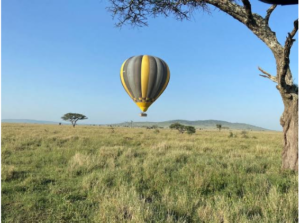
- Optional activities: a Serengeti balloon flight typically costs about $550 to $650 per person.
- Drinks, domestic flights, and beach extensions, where not included.
Sample Per-Person Trip Totals
These examples combine the safari ranges with the extras above. They are illustrative, and exclude insurance.
Budget traveler on a group departure. Seven-day safari at roughly $1,750 to $2,800, plus about $900 to $1,200 in flights, a $50 visa, $70 to $140 in tips, and $150 to $350 in health costs. A total of about $2,900 to $4,500 per person.
Couple on a private mid-range trip. Safari at roughly $3,150 to $5,600, flights of about $1,200 to $1,800, plus visa, tips, and health. A total of about $4,600 to $7,900 per person.
Luxury couple. Eight days at $850 to $1,500 or more per day, plus premium flights and extras. A total of roughly $9,600 to $17,700 or more per person.
How to Lower Your Cost Per Person
- Share the vehicle. Travel with a group, family, or another couple to split vehicle and guide costs.
- Choose a small-group departure if you are traveling solo.
- Travel in shoulder or green season, when rates and single supplements are lower.
- Drive instead of fly between parks when time allows.
- Compare itemized quotes to see exactly what each price includes.
- Book early for peak months.
- Avoid suspiciously cheap prices, since park fees and logistics set a realistic minimum.
Conclusion
The cost of a Tanzania safari cost per person is not a fixed figure. It depends on how many people share your vehicle, whether you travel alone, which accommodation you choose, and which season you visit. As a baseline, expect roughly $250 to $400 per person per day for budget trips, $450 to $800 for mid-range, and $850 to $1,500 or more for luxury, then adjust for group size, single supplements, and children. Because per-vehicle costs fall as more people share, traveling with others is the single most effective way to lower the per-person price. Compare itemized quotes, add the extras that are rarely included, and choose an operator who explains the numbers clearly. With that clarity, you can plan a safari that fits your budget and still delivers the experience you came for.
Key Takeaways
- Typical rates are roughly $250 to $400, $450 to $800, and $850 to $1,500 or more per person per day for budget, mid-range, and luxury trips.
- Some costs are charged per person, such as park fees and accommodation, while others are charged per vehicle, such as the guide and the Ngorongoro Crater fee.
- Sharing a vehicle can cut the vehicle-related cost per person dramatically, from about $2,400 for a solo traveler to about $400 for a group of six in a simple seven-day example.
- Solo travelers pay the most, because they carry the vehicle cost and often a single supplement.
- Children pay lower park fees, but accommodation policies and flights vary.
- International flights, visa, tips, insurance, health costs, and optional activities are usually extra.
- Compare itemized quotes and confirm current fees before booking.
Frequently Asked Questions
- How much does a Tanzania safari cost per person? Roughly $250 to $400 per person per day for budget, $450 to $800 for mid-range, and $850 to $1,500 or more for luxury, based on two people sharing.
- Why is a safari more expensive for solo travelers? Solo travelers carry the full cost of the vehicle and guide and often pay a single supplement for a room, so the per-person price is higher.
- Does the price per person fall with a bigger group? Yes, for the vehicle-related portion. Park fees and accommodation stay the same per person, but sharing the vehicle and guide reduces the per-person cost noticeably.
- How much is the vehicle and driver-guide? A rough flat rate for a private 4×4 with a driver-guide is often cited at around $300 per day, though it varies by operator and season.
- Do children pay less? Park fees for children are much lower, and under-fives are free in many parks, though accommodation policies vary. Ask for separate adult and child pricing.
- What is the single supplement? It is an extra charge for occupying a double room alone. It varies by camp and season, and is sometimes reduced or waived outside peak months.
- What does the per-person price usually include? Typically accommodation, meals, park fees, a vehicle with a driver-guide, and transfers. Always confirm exactly what is covered.
- What costs are not included? International flights, visa, tips, insurance, health costs, drinks, optional activities such as balloon flights, and sometimes domestic flights.
- How can I reduce my cost per person? Share the vehicle, join a small-group departure, travel in shoulder or green season, drive instead of flying, and compare itemized quotes.
- Is a group tour cheaper than a private tour? Usually yes per person, but a private tour offers more flexibility and privacy. The best choice depends on your budget and travel style.

